Une journée typique du
Professeur David

A typical day for
Professor David

Een typische dag voor
Professor David

  • La coupole
  • Le télescope
  • Le professeur David répond à vos questions
  • L'observation du Soleil
  • L'image projetée du Soleil
  • Le nombre de Wolf
  • Un carton de relevé des taches solaires
  • The dome
  • The telescope
  • Prof. David answers your questions
  • Observing the Sun
  • The projected image of the Sun
  • The Wolf Sunspot number
  • A drawing of observed Sunspots
  • De koepel
  • De telescoop
  • Prof. David beantwoordt uw vragen
  • De zon waarnemen
  • Het geprojekteerde beeld van de zon
  • Het Wolf zonnevlekgetal
  • Een tekening van de waargenomen zonnevlekken


  •  
    La coupole / The dome / De koepel
    Il est tôt le matin à l'Observatoire Royal à Uccle, mais déjà les scientifiques travaillent et la coupole est ouverte. Le ciel dégagé et le beau temps vont leur permettre d'observer en toute quiétude leur sujet d'étude de prédilection: le Soleil. Les observations sont de meilleure qualité le matin, ou au midi vrai, lorsque le Soleil culmine dans le ciel. En effet le matin la pollution ne contamine pas encore l'atmosphère de Bruxelles et le point de culmination est le point où les rayons du Soleil traversent le plus directement notre atmosphère. Cela permet ainsi aux astronomes d'éviter une grande partie des interférences dues aux différentes couches atmosphériques qui entourent le globe terrestre. La coupole est rotative permettant ainsi des observations dans toutes les directions et donc tout au long de la journée.  It is early in the morning at the Royal Observatory in Uccle, but already the scientists are at work and the dome is open. The sky is clear and the nice weather will allow them to observe all quietly their favourite subject: the Sun. Observations are always of better quality in the morning or at true noon when the Sun is at the culmination point in the sky. Indeed, in the morning, the pollution does not yet contaminate the atmosphere above Brussels and the culmination point is the point where the solar rays cross our atmosphere the most directly. This allows then the astronomers to avoid a major part of the interferences due to different atmospheric layers that surround the terrestrial globe. The dome is rotary, giving thus the possibility to observe in all directions and at any time of the day.   Het is vroeg in de ochtend op de Koninklijke Sterrenwacht in Ukkel, maar de wetenschappers zijn aan het werk en de koepel is geopend. De hemel is klaar en het goede weer maakt het hun allen mogelijk om rustig hun favoriete hemelobjekt te observeren: de zon. Waarnemingen zijn altijd van betere kwaliteit wanneer ze gebeuren in de ochtend of op ware middag. Inderdaad, want 's morgens is de atmosfeer boven Brussel minder vervuild en 's middags staat de zon in het culminatiepunt waardoor de lichtstralen de kortste weg afleggen doorheen de atmosfeer. Dit staat de astronomen toe om het grootste gedeelte van de storingen van de verschillende luchtlagen te vermijden. De koepel is draaibaar, wat de mogelijkheid geeft om op elk ogenblik van de dag in eender welke richting waar te nemen.


    Le télescope / The telescope/ De telescoop
    A l'intérieur de la coupole, le télescope que l'on utilise (celui du milieu) est fixé avec deux autres télescopes sur une table équatoriale. Cette table tourne sur deux axes, pour suivre le mouvement relatif du Soleil dans le ciel par rapport à notre position sur la terre. La table peut être manipulée manuellement ou mécaniquement. Cela permet au Professeur David de pouvoir orienter convenablement la lunette vers l'endroit du ciel visé. Le télescope est un réfracteur avec une lentille de 150 mm de diamètre et une longueur focale de 2400 mm. Inside the dome, the telescope that is used (the middle one) is fixed with two other telescopes to an equatorial table. This table turns around two axes, to follow the relative movement of the Sun in the sky with respect to our position on Earth. The table can be manipulated manually or mechanically. This allows Professor David to properly point the telescope towards the spot of the sky that he aims for. The telescope is a refractor with an objective lense diameter of 150 mm and a focal length of 2400 mm. Binnen de koepel staat de telescoop die gebruikt wordt (in het midden). Ze is bevestigd, tezamen met twee andere telescopen, aan een equatoriale tafel. Deze tafel draait op twee assen, om de relatieve beweging van de zon aan de hemel te volgen ten opzichte van onze positie op aarde. De tafel kan ofwel manueel ofwel mechanisch bewogen worden. Dit staat Professor David toe om de telescoop gemakkelijk te richten naar een gekozen plek aan de hemel. De telescoop is een refractor met een objektief lens diameter van 150 mm en een brandpuntsafstand van 2400 mm.


    Le professeur David  répond à vos questions / Prof. David answers your questions / Prof. David beantwoordt uw vragen
    Ah ! Voici le Professeur David.
    - Bonjour Professeur, pourriez-vous répondre à quelques questions concernant le télescope?
    - Bonjour, oui bien sur.
    - Quel âge a le télescope?
    - Le télescope a été construit dans les annnées 50 et mis en fonction dés 1957 pour l'Année Internationale de Géophysique. C'était alors un instrument photographique complètement automatisé (électromécaniquement).
    - Et combien coûte ce télescope?
    - Je ne sais pas mais ça doit bien valoir plusieurs centaines de millier d'euro, sans compter le dôme et le bâtiment.
    - Quelle est l'agrandissement de l'image projetée ?
    - Parce que c'est une image projetée, on ne peut parler d'agrandissement. Elle a simplement un diamètre de 25 cm et l'objectif de 15 cm donne à peu près 2 secondes d'arc de résolution au mieux (limitée par les effets de l'atmosphère). Ce qui se traduit par des détails aussi fins que 0,25 mm dans l'image. La terre est de l'ordre de 2,5 mm à la même échelle. 
    - Meci beaucoup Professeur, nous allons maintenant vous laisser continuer à travailler.
    Ah ! Here comes Professor David.
    - Good morning Professor, would you like to answer some questions related to the telescope?
    - Good morning, yes of course.
    - How old is the telescope?
    - The telescope was built in the 50s and completed around 1957 in view of the International Geophysical Year. It was then a fully automated (electromechanical) photographic instrument.
    - And how much does a telescope like that cost?
    - I don't know, but this must cost several hundreds of thousand of euros, without counting the dome and the building.
    - What is the magnification of the projected image?
    - As it is a projected image, you cannot speak about magnification. The image simply has a diameter of 25 cm and with the 15 cm objective, this gives about a 2 arcsec resolution at best (limited by atmospheric seeing). This translates into 0.25 mm for the finest details in the image. The Earth would be about 2.5 mm at the same scale.
    - Thank-you very much Professor, we let you now continue with your work.
    Ah ! Hier komt Professor David.
    - Goedemorgen Professor, zou ik U wat mogen vragen over de telescoop?
    - Goedemorgen, jazeker.
    - Hoe oud is de telescoop?
    - De telescoop werd gebouwd in de jaren 50 en werd voltooid rond 1957 in het kader van het Internationale Geofyschische Jaar. Het was indertijd een volledig geautomatiseerd (elektromechanisch) fotografisch instrument.
    - En hoeveel kost zo'n telescoop?
    - Ik weet het niet precies, maar het kost ongeveer verschillende honderdduizenden euros, zonder hierbij de koepel en het gebouw in rekening te nemen.
    - wat is de vergroting van het geprojekteerde beeld?
    - Het is een geprojekteerd beeld, dus je kan niet echt van een vergroting spreken. Simpelweg geeft een diameter voor het beeld van 25 cm, tezamen met de telescoop objektief van 15 cm, een grootste resolutie van 2 boogsekonden (afhankelijk van de atmosferische seeing). Dit vertaalt zich in een grootte van 0.25 mm voor de kleinste details in het beeld. De aarde zou ongeveer 2.5 mm groot zijn op dezelfde schaal.
    - Dank U hartelijk Professor, we laten U uw werk voortzetten.


    L'observation du Soleil / Observing the Sun / De zon waarnemen
    Mais rien est simple, car le Prof. David ne peut pas risquer de regarder directement le Soleil à travers le télescope. Heureusement un viseur constitué de deux cercles est là pour faciliter la tâche de notre jeune astronome. Lorsque les ombres des deux cercles se confondent cela signifie que les lentilles du télescope sont alignées sur le Soleil.  But nothing is simple, because Prof. David cannot risk a direct look through the telescope to see the Sun. Fortunately a sighting tube formed of two circles is there to help our young astronomer. When the shadows of the two circles meet, this means that the lenses of the telescope are aligned on the Sun. Maar niets is eenvoudig, omdat Prof, David niet mag riskeren direkt door de telescoop naar de zon te kijken. Gelukkig is er een zoeker bestaande uit twee cirkels om de jonge astronoom te helpen. Wanneer de schaduwen van de twee cirkels opelkander passen, betekent dit dat de lenzen van de telescoop gericht staan naar de zon.


    Un boîtier de commande dirige de petits moteurs sur les axes et permet de centrer précisément l'image du Soleil sur le carton. A command box controls little motors on the axes and allows the precise centering of the solar image on the cardboard. Een toestel bedient de kleine motoren op de assen en maakt het mogelijk om het beeld van de zon precies op het karton te centreren.


    Quelques derniers réglages, et enfin David voit sa peine récompensée. Il a réussi à faire apparaître la projection du Soleil sur son carton d'observation.
    Il doit faire correspondre le disque solaire avec le cercle pré-dessiné sur le carton. 
    Some last adjustments, and finally David sees its efforts rewarded. He has succeeded to bring out the projection of the Sun on his observation cardboard.
    He has to match the solar disk with the pre-drawn circle on the cardboard.
    Enkele laatste aanpassingen, en uiteindelijk ziet David zijn moeite beloond. Hij is er in geslaagd om de zon te projekteren op het observatiekarton.
    Hij moest de zonneschijf doen samenvallen met een voorgetekende cirkel op het karton.


    L'image projetée du Soleil / The projected image of the Sun / Het geprojekteerde beeld van de zon
    Malheureusement les fréquents nuages belges jouent parfois des tours aux astronomes. Il faut alors attendre que le nuage soit passé pour pouvoir continuer l'observation. Heureusement la table équatoriale permet au télescope de suivre la course du Soleil dans le ciel. Ou, pour être plus exact, cette table tourne à la même vitesse mais en sens contraire de la Terre, permettant ainsi, une fois que le Soleil est trouvé, de le maintenir à l'intérieur du cercle d'observation. Unfortunately the frequent belgian clouds sometimes play tricks to the astronomers. One must wait for the cloud to pass to be able to continue observing. Fortunately the equatorial table allows the telescope to follow the course of the Sun in the sky. Or, to be more precise, this table turns at the same speed but in the other direction than the Earth, which allows therefore to keep the Sun, once it is found, inside the circle of observation. Spijtig genoeg spelen de frequente Belgische wolken de astronomen parten. Dan moet men wachten totdat de wolk gepasseerd is om de waarneming voort te zetten. Gelukkig blijft de telescoop, door de equatoriale tafel, de beweging van de zon aan de hemel volgen. Of om het meer precies uit te drukken: de tafel draait aan de dezelfde snelheid als de aarde, maar in tegengestelde richting. Hierdoor blijft de zon, eens gevonden, altijd binnen de cirkel van het waarnemingskarton.


    Le nombre de Wolf / The Wolf Sunspot number / Het Wolf zonnevlekgetal
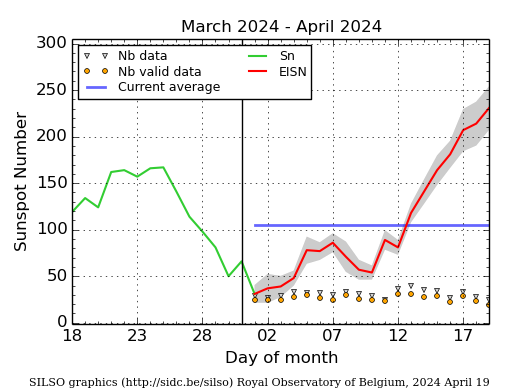
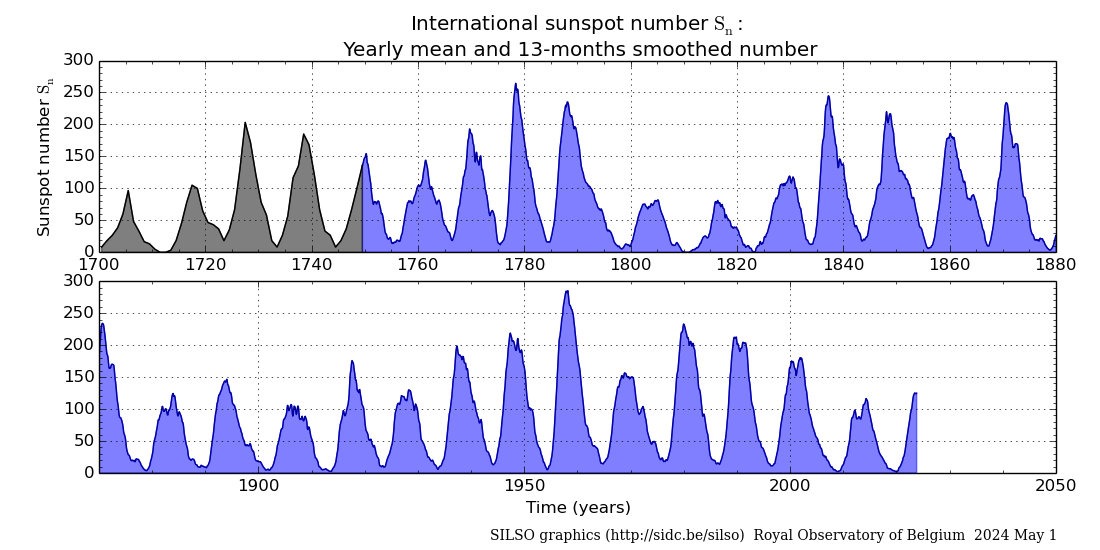
    Lorsque les nuages partent, le professeur David peut enfin faire un relevé des taches solaires. En effet le centre SIDC à l'ORB, jour après jour observe, dénombre et suit l'évolution des diffèrentes taches solaires, calculant ainsi une variable appelée "nombre de Wolf". Notre département fournit à l'observatoire des observations journalières du disque photosphérique du Soleil, et cela depuis trente ans. L'observation consiste à dessiner la position des taches et des groupes de taches sur le carton. Le nombre de Wolf est calculé en multipliant par dix le nombre de groupes et en y additionnant  le nombre de taches solaires. Le nombre de Wolf varie de manière périodique au long d'un cycle de 11 ans, avec des valeurs comprises entre 0 et 150 (ou plus) en fonction de l'intensité de l'activité solaire When the clouds are gone, the professor David can finally draw the Sunspots. Indeed the SIDC at the ROB, day after day observe, count and follow the evolution of the different Sunspots, thus producing a variable called the "Wolf Sunspot number". Our department has been providing the observatory with daily observations of the photospheric solar disk for thirty years. The observation consists in drawing the position of Sunspots and groups of spots on the cardboard. The Wolf Sunspot number is calculated by multiplying by ten the number of groups and adding to it the number of Sunspots. The Wolf number varies in a periodical way during a cycle of 11 years, ranging between 0 and 150 (or more) according to the intensity of the solar activity. Wanneer de wolken verdwenen zijn, kan Prof. David eindelijk de zonnevlekken tekenen. Inderdaad, het SIDC van de KSB neemt dag na dag de zonnevlekken waar, telt ze en volgt de evolutie van de verschillende zonnevlekken. Hiermede wordt een parameter geproduceerd, die het "Wolf zonnevlekgetal" heet. Ons departement verzorgt al sinds dertig jaar dagelijke waarnemingen van de fotosferische zonneschijf. De waarneming bestaat erin om de positie van de zonnevlekken en zonevlekgroepen op het karton in te tekenen. Het Wolfgetal wordt berekent als tien maal het aantal zonnevlekgroepen plus het totaal aantal zonnevlekken. Het Wolfgetal varieert periodisch gedurende een cyclus van 11 jaar tussen waarden van 0 en 150 (of meer), afhankelijk van de intensiteit van de zonneaktiviteit.


    On peut voir ici le scientifique en pleine action qui commence à dessiner les taches et les plages sur le carton. Ce travail demande beaucoup de patience et de précision. One can see here the scientist in action, who starts drawing the Sunspots and the plages on the cardboard. This work requires lots of patience and precision. Hier zien we de wetenschapper in aktie. Hij begint de tekening van zonnevlekken en plages op het karton. Dit werk vergt veel geduld en nauwgezetheid.


    Un carton de relevé des taches solaires / A drawing of observed Sunspots / Een tekening van waargenomen zonnevlekken
    Ci-dessus, vous pouvez voir un carton après une observation. Les taches solaires y ont été reproduites, dénombrées et groupées. Vous pouvez cliquer sur cette image pour l'agrandir et pour obtenir de plus amples détails. Above you can see a cardboard after an observation. The Sunspots have been reproduced, counted and grouped. You can click on this picture to enlarge it and to obtain more details. Hierboven ziet U een karton nadat de waarneming is voltooid. De zonnevlekken zijn ingetekend, geteld en gegroepeerd. U kan op het beeld klikken voor een grotere versie en om meer informatie te verkrijgen.


    Links

    On the site of SIDC (Solar Influences Data analysis Center), the Data Sunspot page.


    March 29th, 2002
    Webmaster : Jean-Yves Ledent


    RealisationJean-Yves Ledent, Claire Foullon and Erwin Verwichte
    Original French textJean-Yves Ledent
    Translationsto English by Claire Foullon
    to Dutch by Erwin Verwichte
    Photographstaken by Goedele Duran
    scanned by David Berghmans
    FigurantDavid Berghmans
    in reality a permanent member of the research staff of the observatory,
    does not hold a title of professor.
    Solar observationOlivier Boulvin
    Telescope questions from the publicgathered by Ronald Van der Linden
    answered by Frédéric Clette